
IMDb What to Watch
“Sitting in front of the TV, it's always like, 'what do you want to watch' - you know? And you're looking at all of these channels - you've got Netflix and Amazon Prime and Disney +. And you've got cable. We've got it all. And we don't know what to choose. It's very frustrating.”
— Entertainment Fan, CA, Female, Age 52
Summary
Role
Lead UX Designer
(sole designer 14 months, then co-lead)
Timeline
2021–2024
Team
8-person core team
40+ collaborators across IMDb and Fire TV
Platform
Amazon Fire TV (exclusive)
Outcome
Launched May 2022
Sunset July 2024
Overview
IMDb What to Watch was a free TV app that turned finding something to watch into a shared experience. A set of interactive games that helped families, couples, and individuals discover what to watch together. I led the UX from inception through launch, designing the core interaction model, the game framework, the visual language, and the end-to-end experience. It was the most ambitious thing I've ever worked on. It was also sunset two years after launch.
This is the story of what we built, what worked, what didn't, and what I learned.


The Problem
We’ve all been there. It’s Friday night. You're on the couch. Friends or family are settling in. The pizza has arrived. You turn on the TV. Rows of streaming apps, trending shows, recently released movies.
"So. What should we watch?"
With millions of options across an ever-changing sea of services — not to mention the preferences of everyone in the room — the joy of connecting over a movie has become a chore.
Customers are most often with friends and family when they're open to recommendations
Top two unmet needs: (1) evaluating options against situational criteria with less disagreement, and (2) getting introduced to content more relevantly, without overwhelm
TVs are hard (remote typing), shared (many opinions), and ephemeral (this moment)
No product helped a group of people with different tastes reach consensus. Every recommendation engine was built for individuals. This was especially true for IMDb.


The Vision
In 2021, a few of us at IMDb asked: what if finding something to watch was not only painless, but fun? What if it felt less like scrolling through Netflix and more like pulling a board game off the shelf — something anyone could sit down and do together?
We wrote tenets:
Our app is the journey, not the destination. The less time customers spend in our app, the better. We get them to playback.
Our app is not a storefront for content. We prioritize fun, simple methods for discovery that reveal surprising suggestions — not traditional browsing.
We provide a selection, not one "perfect" recommendation. We guide customers to content that matches their moment.
We remember household behavior, not individual preferences. The TV is a shared device.
Our advertising does not interrupt the critical moments of finding or choosing. Ads complement, never replace.
The Process
Design sprint (May 2021)
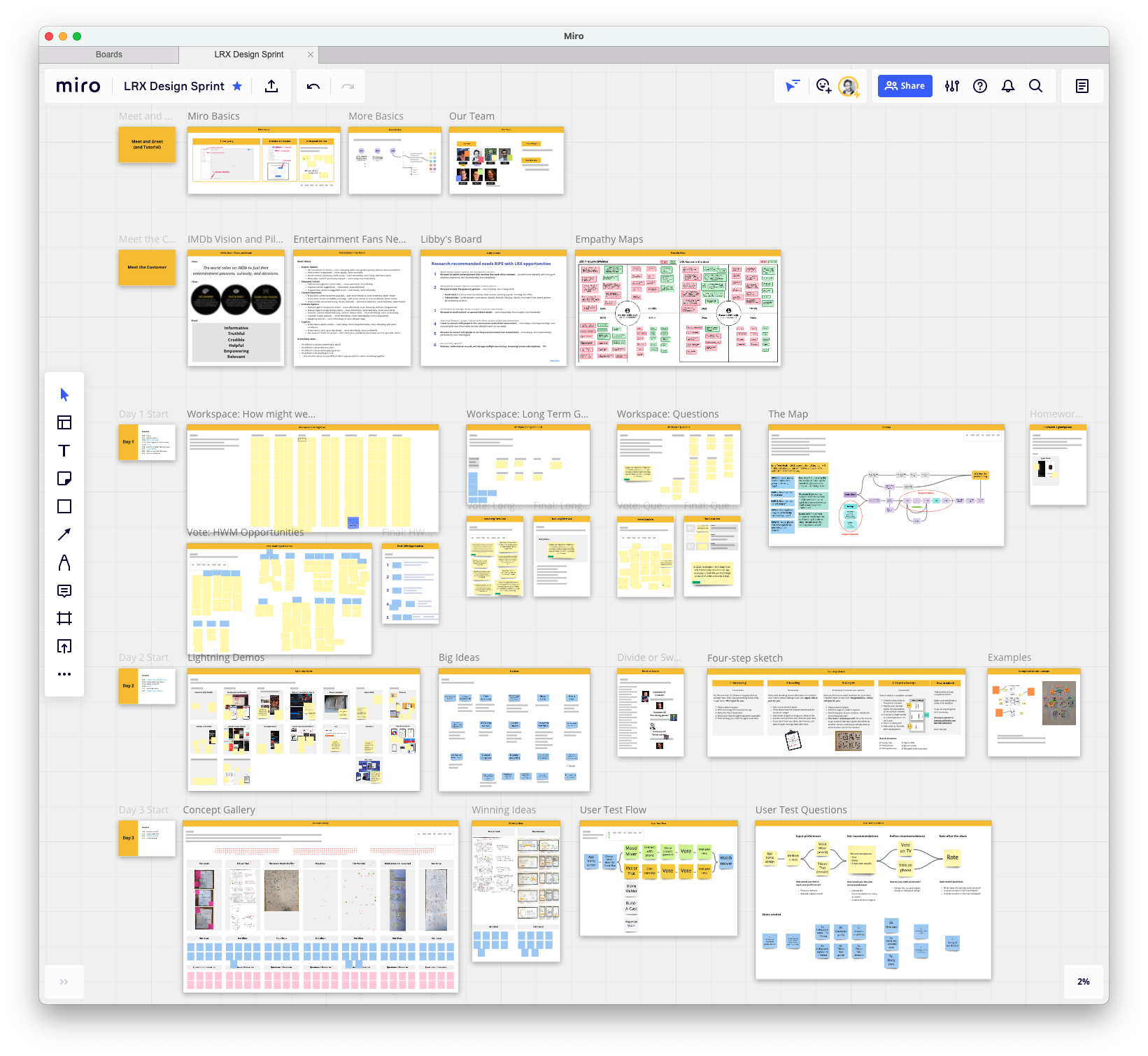
The very first week we were an official team, I led an 8-person design sprint: UX designers, engineers, PMs, and stakeholders. We reviewed research, met with experts, identified customer problems, translated them into opportunities, and generated divergent solutions, all remotely.
We identified the fundamental unmet problem: group decision making. Individual recommendation engines exist everywhere. But no product helped a group of people with different tastes reach consensus on what to watch together.
The winning concept
I pitched a gallery of methods. Provide customers with various ways of using IMDb's data to help everyone in the living room express preferences, narrow options, and agree.

Research validation (May 2021)
We showed sketches to families in moderated research sessions. Every participant described the concepts as "a fun game." They were relieved by the idea that finding something to watch could be an enjoyable bonding activity rather than a frustrating negotiation. The ideal method changes from scenario to scenario. An app with multiple methods would be most helpful.

Our lead researcher, Sharon Chou, interviewing one of our study participants.
The Games
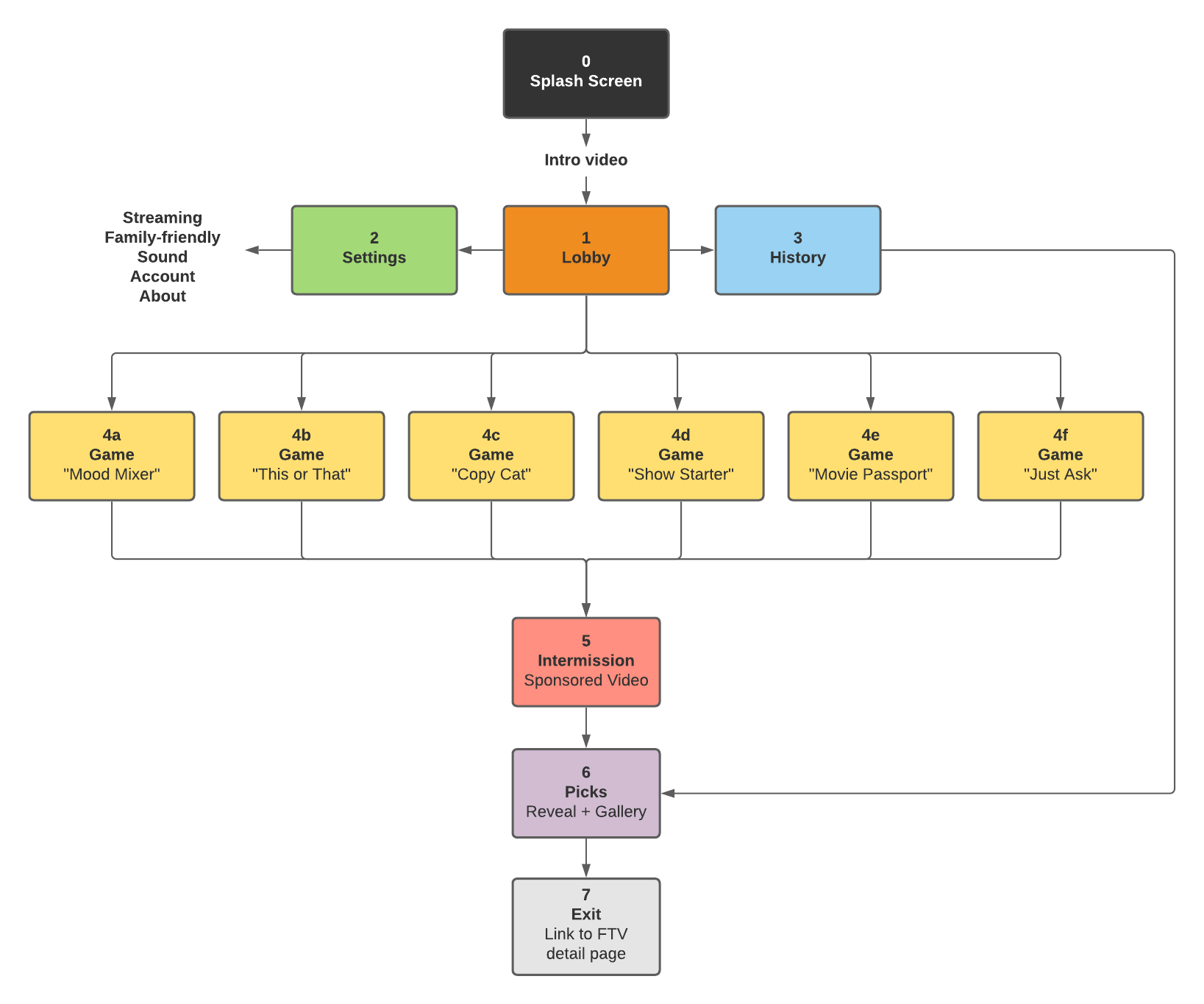
Game logic and templates
Every game concept mapped to one of these templates. Once a template was built, it could power multiple games with different themes and inputs. I identified three fundamental game templates:
Similarity: recommendations mirror selected titles ("I liked this, show me more")
Filter: recommendations match selected metadata ("Show me 90s comedies under 2 hours")
List: recommendations are editorially curated or personalized
Game brainstorm and testing (July 2021)
I invited the entire company to a brainstorm. Together we generated 60 game ideas. The team voted on 20 to show customers. In a card-sorting study across US, UK, Canada, and India (n=60), participants ranked games by helpfulness across four scenarios: solo, couple, family, and large group.
The most helpful games were described as quick, simple, easy, and fun, with "quick" being the most important attribute. After all, our app was the journey, not the destination.
We began with three games:
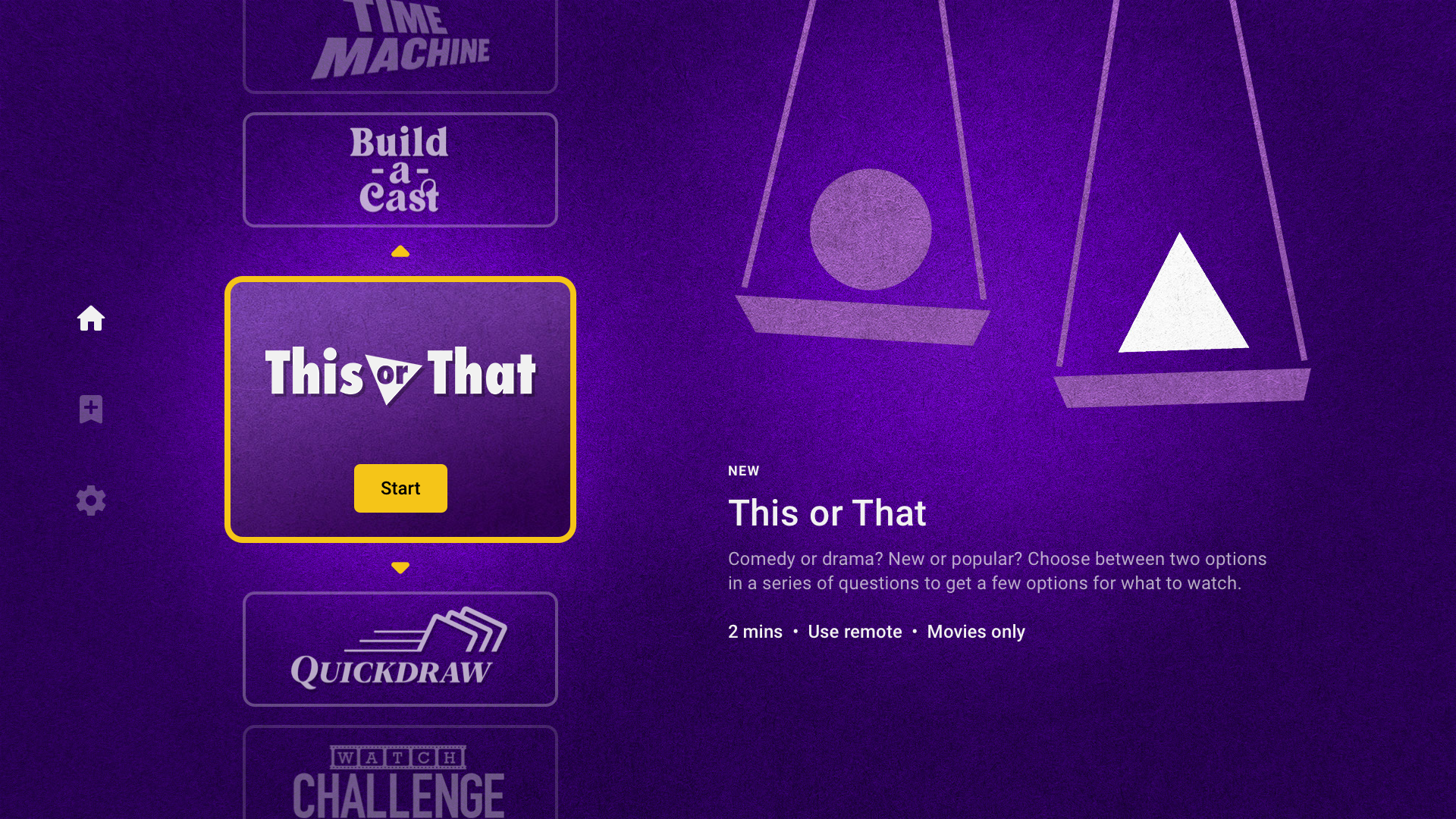
This or That: answer preference questions and we narrow your options (filter template)
Watch Challenge: curated genre lists with stamps and badges (list template)
Quick Draw: shuffle through hundreds of options, pin what catches your eye (similarity template)

Our first game: “This or That”
The very first game we developed was This or That, which used our filter game template. Our product leader, Jessica Scheibach, came up with the idea for the game in our initial design sprint. The game is simple enough: choose between two options in a series of questions to describe what you’re in the mood to watch. It was popular with customers and was (relatively) simple to build. Or so we thought…
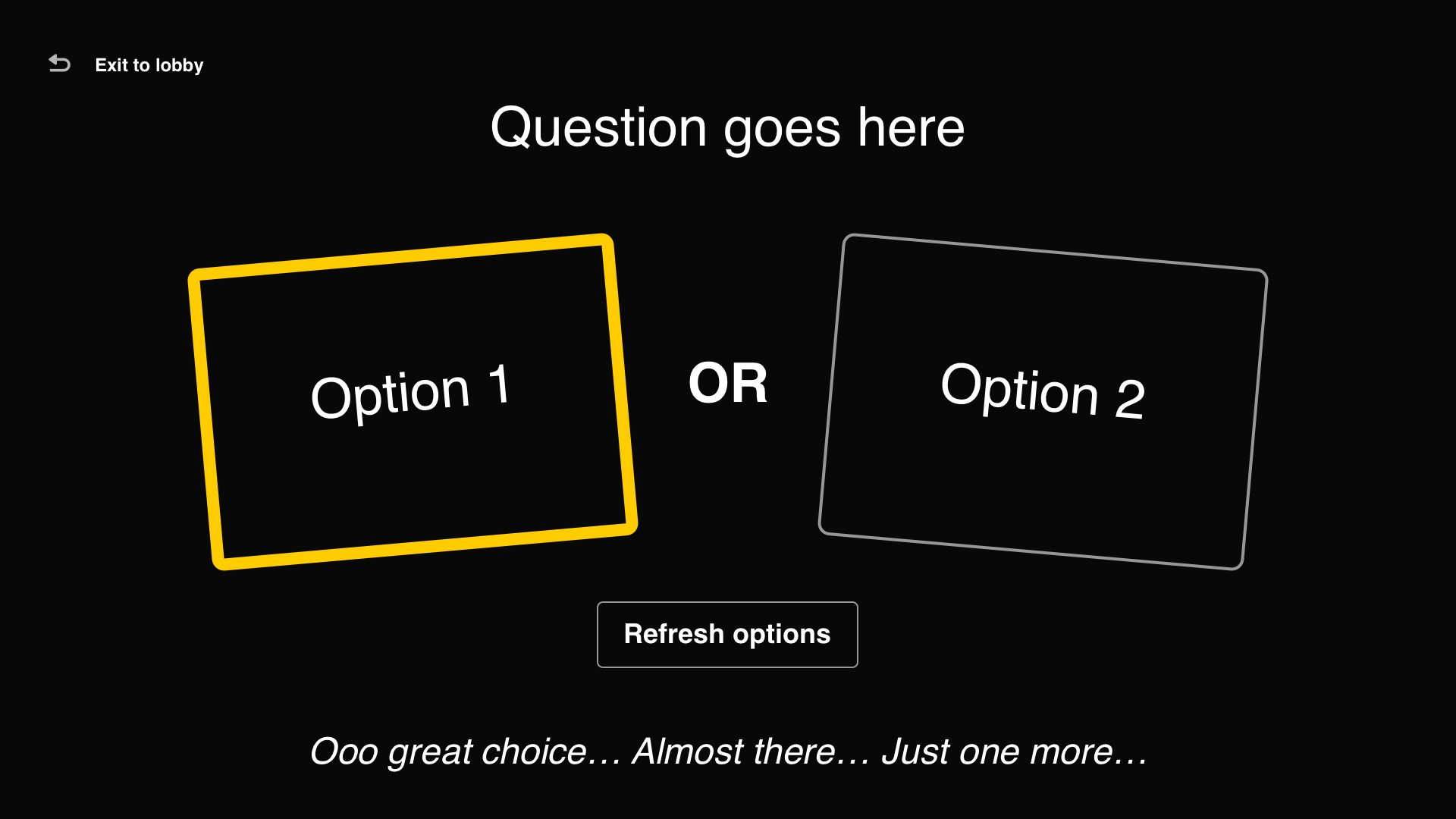
The first problem we discovered was that IMDb was missing a critical piece of information: sub-genres. In order for the recommendations to feel relevant, we needed to provide customers enough granular inputs to describe what they’re in the mood to watch. We would need to partner with IMDb’s Content team to come up with a strategy to properly tag IMDb’s entire catalog.
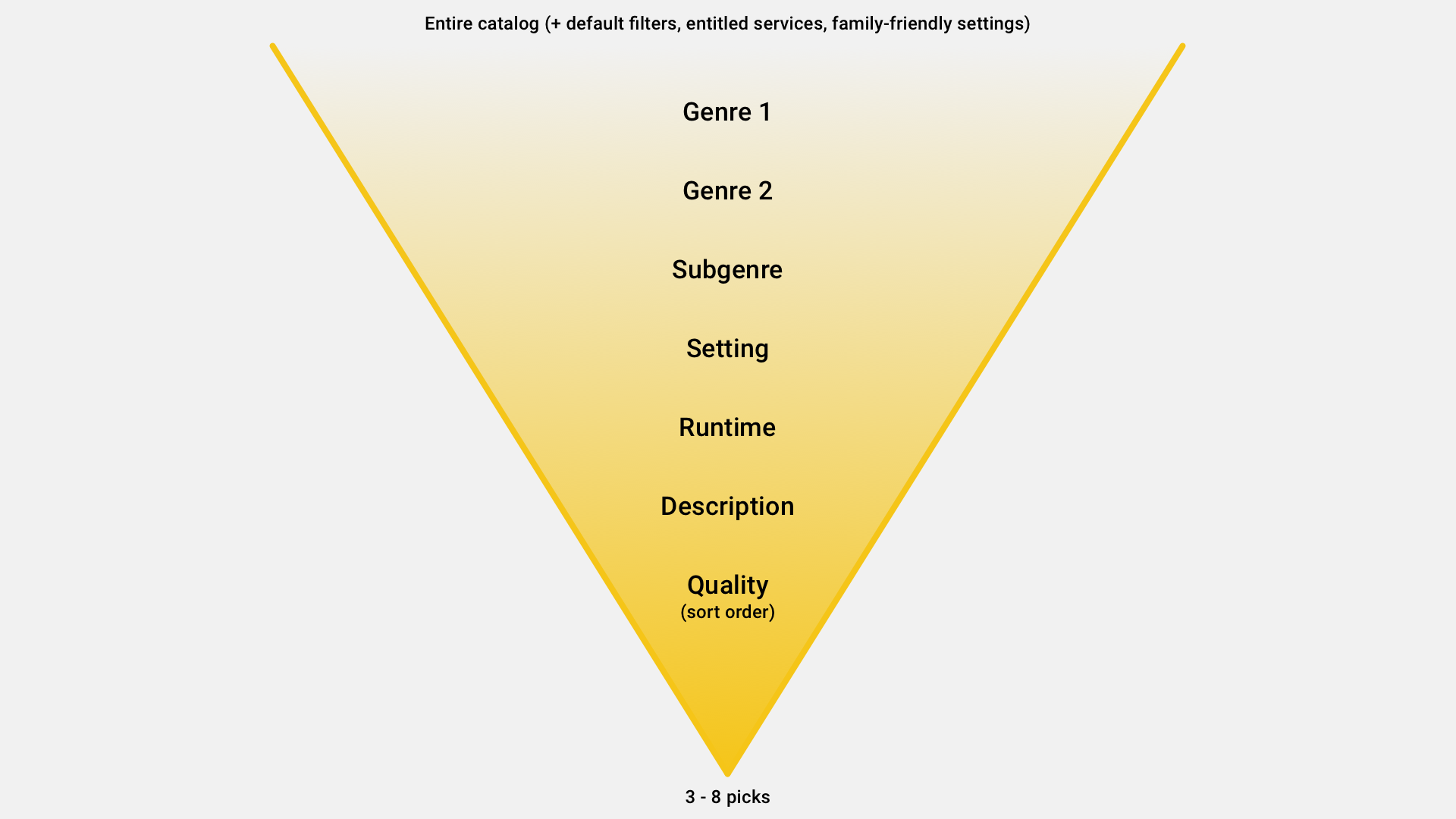
The second problem was that some choice sequences would result in zero results. Technical limitations prevented us from building a more flexible framework that would simply not show options that would result in zero recommendations. We needed to (1) ensure enough content was tagged and (2) design the game logic in a way that would reduce the likelihood of a customer receiving zero results.

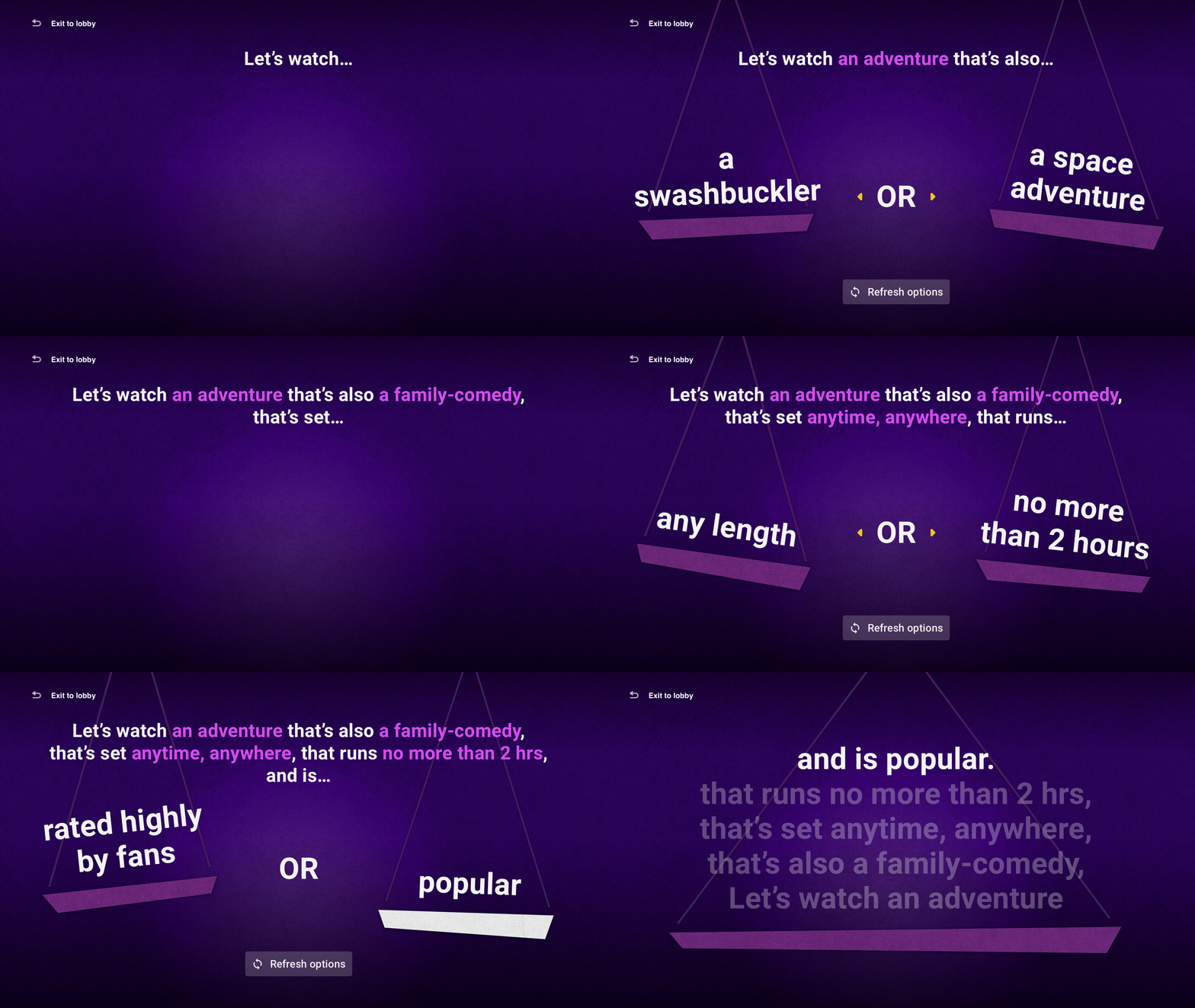
As we manually tagged IMDb’s entire catalog of movies and series with sub-genres, I began to work on the UI for the game. During my design process, I realized that customers would need a record — or a breadcrumb trail — to better visualize how their choices were coming together. I decided to display a sentence at the top that would slowly build as the customer played the game. Building a sentence, however, required some extra work to ensure the structured data appeared grammatically correct — regardless of what options were chosen.

As the UI began to feel more and more like a game show display, like Jeopardy, my UX partner, Kaitlin Powell, suggested that the visuals be brought more inline with Saul Bass: (1) more fun and (2) more metaphorical. She suggested legal scales. She was right.

Visual Language & Branding
Branding
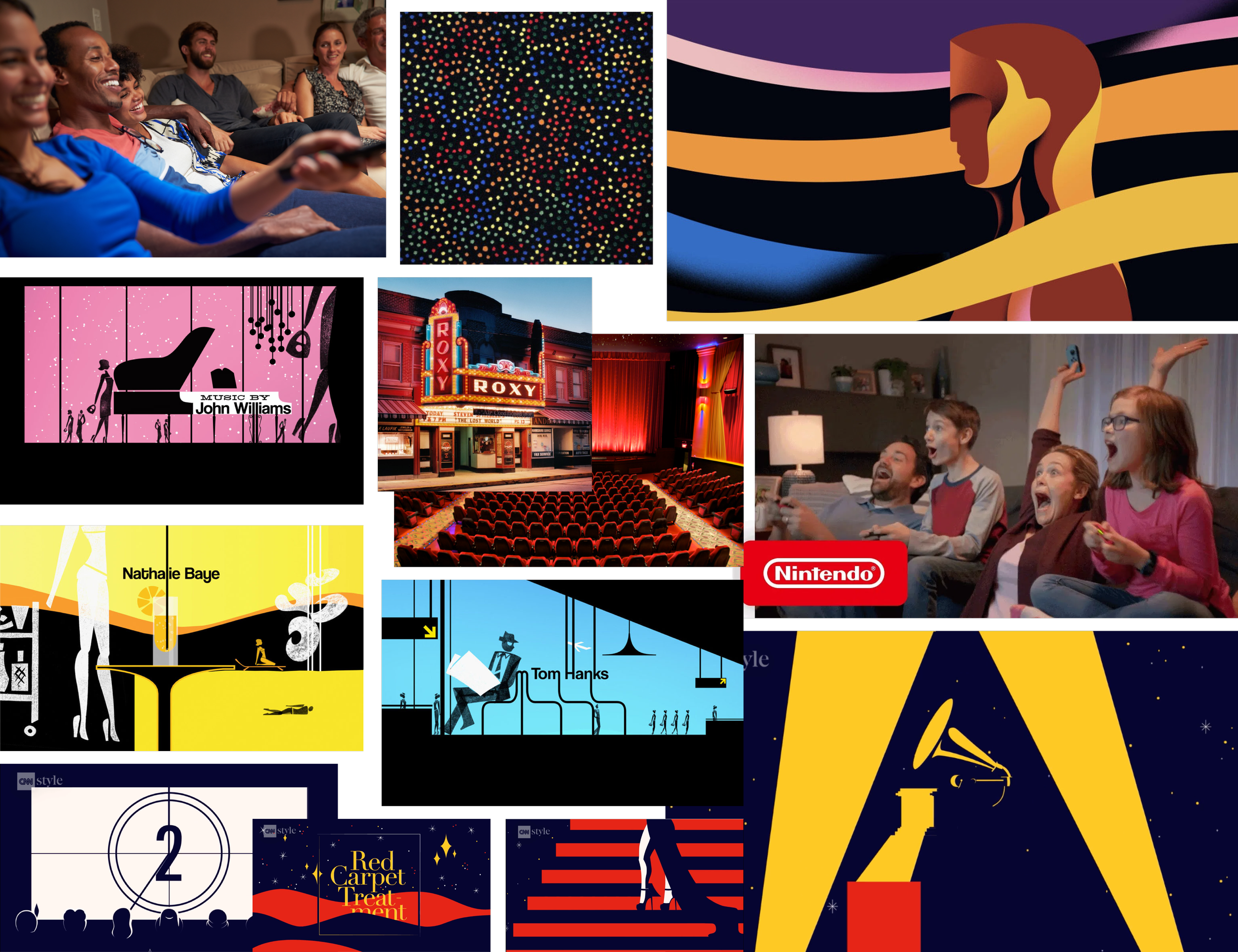
I partnered with Marketing and Creative to define the look and feel. My inspiration: the simplicity of pulling a board game off the shelf. Visually, I looked to Saul Bass. His use of metaphor and flat animation in title sequences bridged cinema and playfulness. Something like the opening of Monsters Inc.
I co-led a brand design sprint to define our personality: fun, trustworthy, inclusive, efficient. We named the app "IMDb What to Watch" after three rounds of brainstorms, voting, and legal vetting.
Belief is a must
We hired Seattle’s Belief Agency to help us develop the animations, videos, music and sound effects for the experience. I provided art direction throughout the process.
Launch animation
Onboarding video
Intermission
Our tenet for advertising stated that ads would not interrupt the critical moments of finding or choosing content. In order to meet our monetization goals without interrupting the customer journey, I invited the intermission. My strategy was to create an opportunity for video ads outside of (1) customers expressing their preferences for what to watch and (2) customers evaluating and choosing what to watch. The intermission would occur after a game, but before the recommendations were revealed.
Intermission
Music
One of my greatest delights was when I first heard the score Andy composed for the app.
The Lobby
For the interface, I simplified the UI to a single focus state (gold = your current selection) and designed a vertical carousel layout for both the game lobby and results gallery, optimized for readability on TV screens and remote-control navigation.
The picks gallery
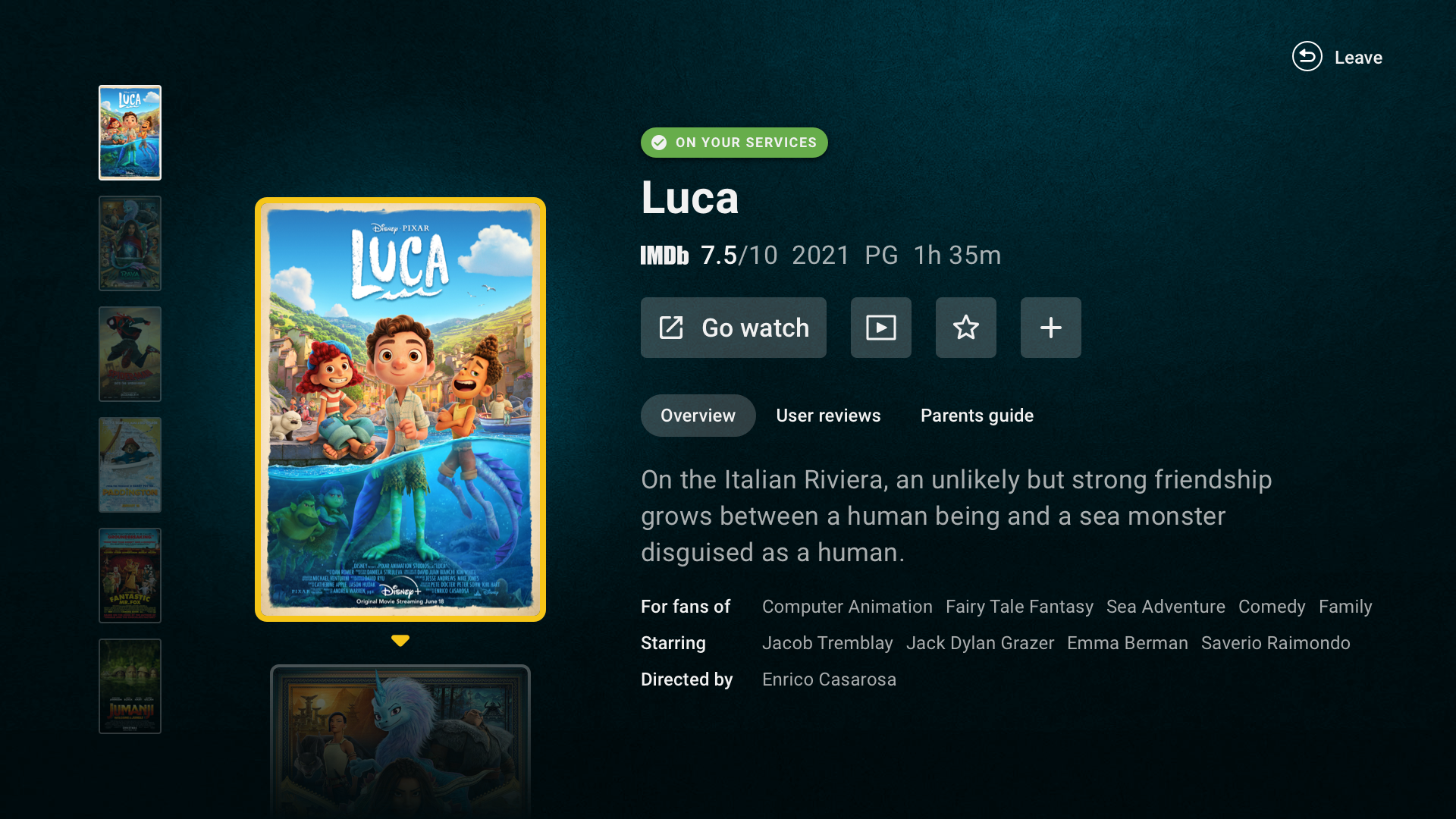
Without question, the most critical part of the experience was the moment when customers would receive and evaluate their recommendations: the picks gallery. Customers needed to understand how many recommendations they were given, easily navigate between them, and evaluate their options against their situational criteria. Customers told us the most important information when making a watch-decision and we removed everything else.
By using progressive disclosure, I was able to use the limited real estate to surface only the most relevant information. The primary actions revealed their labels on focus, and additional information was available via tabs User Reviews and Parents Guide. I added thumbnails of the posters to provide a birds-eye-view of how many options were available. Inspired by how Spotify recolors the background for each album or playlist to create a more immersive and rich experience, we sourced the primary color from the selected poster for the background.
Exit
I considered exiting from the picks gallery as less of a failure and more a part of the process. Rather than bringing the customer back to the lobby, we provided options to restart or fine tune their current game.

Et voila!
The end-to-end experience
Internal BETA launch
In January 2022, we ran an internal BETA of the app across 60 testers drawn from IMDb, Fire TV, and Alexa. Alongside the BETA, I hosted 10 guided research sessions structured to reflect both solo and group contexts, giving us live insight into how the app performed with real people making real decisions on the couch.
The results validated the concept:
43% homework completion rate (26/60 testers), high engagement for internal testing
43 in-app enhancements and bug fixes identified: captured through homework submissions and co-observer notes in the guided sessions
66% of testers rated themselves highly-to-very likely to recommend the What to Watch app to friends and family (top-2 box on a 1-5 scale)
Direct positive quotes on the value proposition, including: "Yes, I would use [the app] with my family especially 1-2x per week."
The BETA gave us a prioritized list of what to fix before launch and confirmed that the core hypothesis (group-friendly, game-based discovery) resonated when customers actually experienced it. Every one of the 43 identified enhancements shipped in the launch build.
Launch
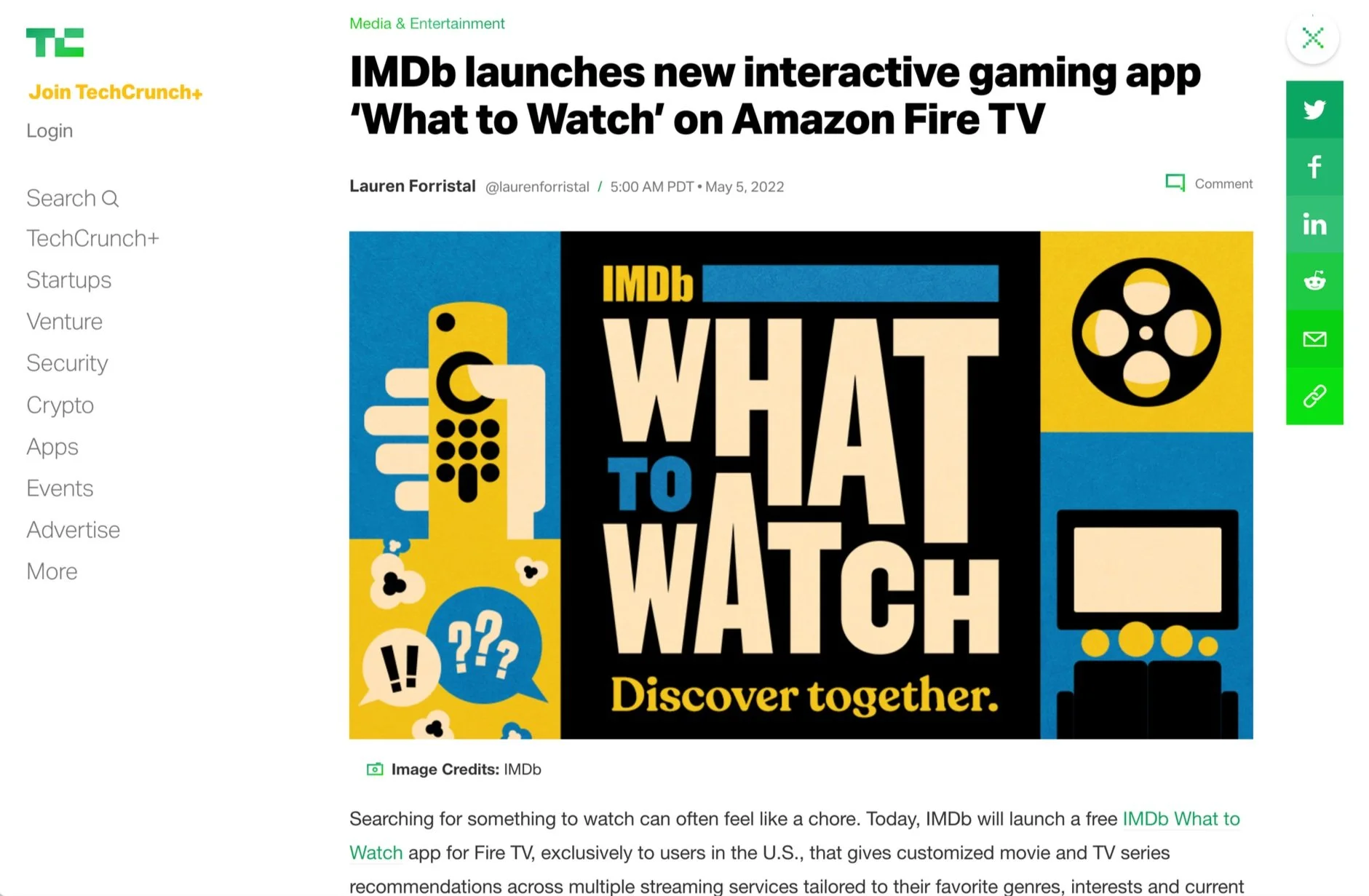
Tech Crunch wrote about our app here
On May 5, 2022, the IMDb What to Watch app launched exclusively on Amazon Fire TV in the US. TechCrunch ran our exclusive. Five articles published on launch day.
Nikki (our CEO) wrote to the company:
"By injecting fun into what can sometimes be a frustrating task, the IMDb What to Watch app makes it possible for entertainment fans to say goodbye to endlessly scrolling... I hope you take a few moments today to celebrate!"
The app was live. Families were playing games together and finding things to watch. The vision was real.
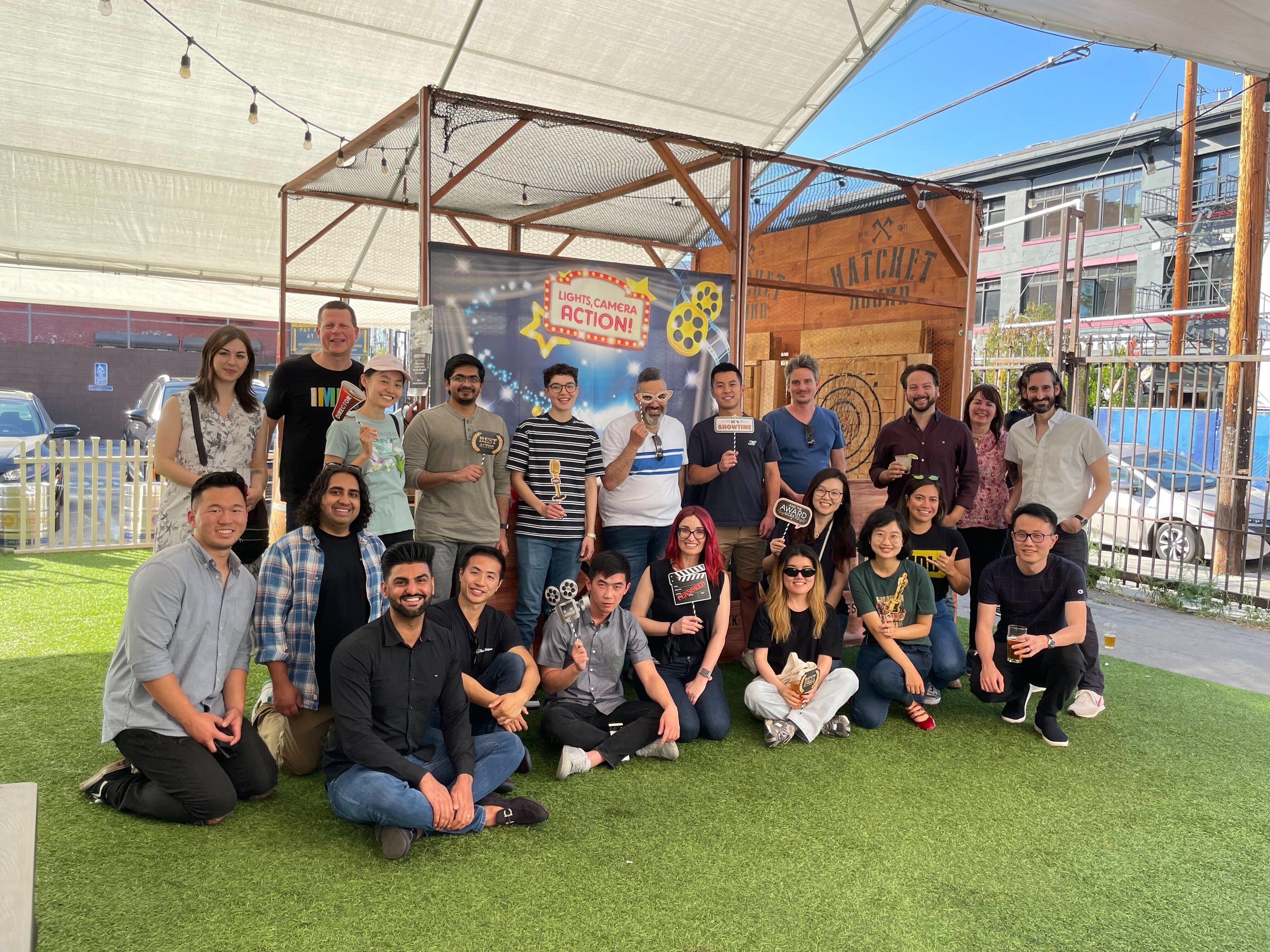
Members of our team celebrating our launch in LA.
Year 1 Metrics
83.6K
337.8K
downloads
users
549K
252K
sessions
watch actions
Customer Voices
“I love that this gives me options to choose from. I think that this is interesting because it doesn't seem like it's pulling based off of my prior watch history like Netflix does... it’s based off of our circumstances at the moment.”
— Entertainment Fan, US, female, age 28
“I like it very much. It narrows down and just gives you a nice selection of movies within what you want. It doesn't give you like 15–20 movies where you go back and forget the first one and you never pick. I LOVE this.”
— Entertainment Fan, US, female, age 43
“Choosing a movie is extremely stressful. So, just by using this app, it put a smile on my face. It's SO different. It's so unique. It's creative. It's innovative. I can be really indecisive. But this narrows it down all the way. I will definitely use this.”
— Entertainment Fan, CA, female, age 18
“This app helps indecisive people (like me) decide on something to watch. It's making finding a movie fun.”
— Entertainment Fan, US, male, age 38

Into each life some rain must fall
The Pivot
Within a few months, leadership grew impatient with adoption. By January 2023, only eight months after the initial launch, the lobby of games was replaced with rows of title recommendations. The app shifted from a "leaned in" (interactive) experience to a "leaned back" (passive) one. It became just another TV app with rows of content.
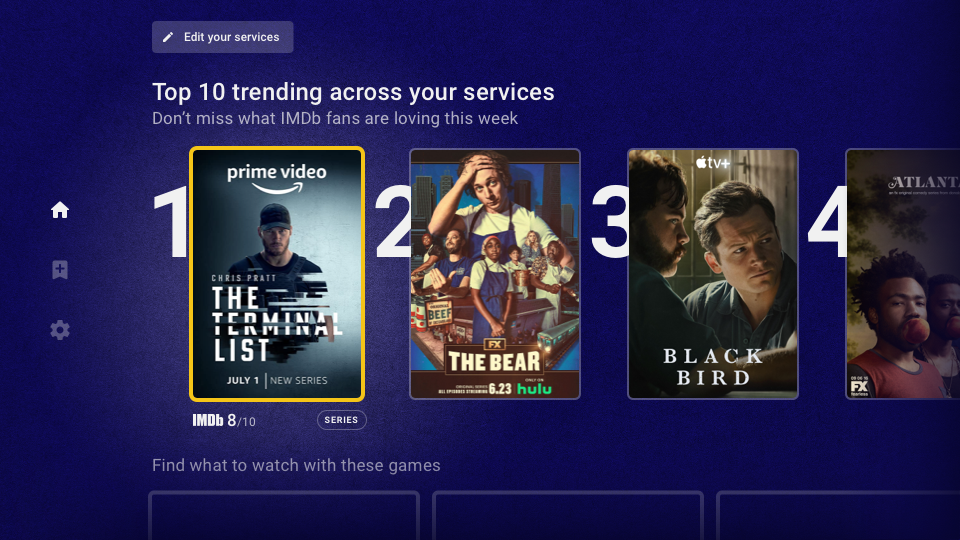
The new lobby design, with rows of suggested content rather than games
Without pre-installation, platform expansion, or prominent placement, we were fighting a distribution battle that design alone couldn't win.
The Sunset
On July 1, 2024, two years after launch, the IMDb What to Watch app was removed from Fire TV.
Reflection
The deepest lesson: we solved the wrong problem first. In the design sprint we aimed at the biggest pain in the living room, group decision-making. But that only happens once or twice a month. The problem we should have led with was the nightly one: "what should I watch tonight?" Solve the frequent problem, earn the daily habit and the repeat visits, and you earn the right (and the audience) to solve the harder, rarer group-decision problem on top of it. For a business that runs on repeat visits and ad impressions, the frequency of the problem matters.
Distribution was the other lesson: a product needs to be complete and available everywhere to be helpful. An app locked to one platform, buried in an app store, requiring discovery and download before it can solve a problem people are having right now, is not a fair test of the idea. It is a test of distribution.
The third lesson: believe in the vision long enough for it to work. Not every great idea gets the runway it needs. That does not make it wrong. It makes it early.
I still believe in this idea, but I would sequence it differently now: win the nightly "what do I watch" habit first, then layer the group-decision ritual on top of the trust and traffic that earns. Group decision-making in the living room remains unsolved, and the experience of choosing together, like browsing the aisles at Blockbuster, is still worth building. The experience of choosing is the experience. And I believe it should feel fun. We just needed to start with the choice people face every night.